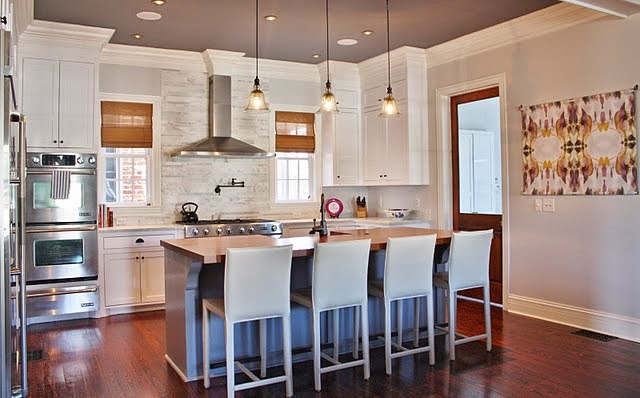
Wednesday, July 8, 2015

The Colorful Outdoor Kitchen

Q.  My husband and I are planning an outdoor kitchen and are looking for some ideas to make it fun.  While we like natural stone and wood, we would prefer NOT to have our decor coordinate with the surroundings.  We want it to stand out!  Any suggestions? 
- Marcy

A.  There are many examples of outdoor spaces that beautifully blend in with the warmer wood and cooler gray tones of stone but it's all been seen before. It sounds like you and your husband are up for some creativity.

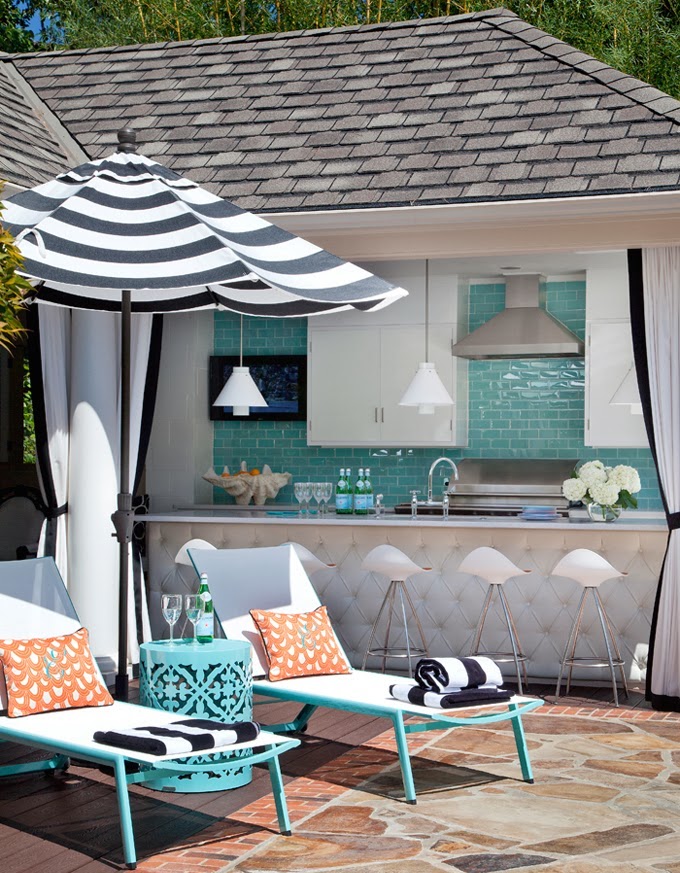
Using bright colors will certainly stand out against the muted green foliage and sky blues. A way to achieve this easily is by adding furniture and other accessories. Take a trip to Pier 1 Imports, Cost Plus World Market, or Target to select chairs, an outdoor rug, or pillows and plates with color and pattern.

You could go a step further by painting or tiling a wall. Try a subway tile but don't settle for white...go turquoise or fuchsia. A big step further is investing in appliances that are colorful such as a refrigerator from Big Chill available in 8 colors (and over 200 custom colors) or a Weber Q 1200 grill available now in six colors.

Lastly, make a statement literally (see image at bottom) with some artwork. Have fun!
- Danielle
http://www.bloglovin.com/blogs/house-turquoise-96586?blog=96586&post=2424455709&viewer=true
image via

Saturday, January 31, 2015

Open Shelving


Q.  
Lately I see open kitchen shelving featured in every magazine and shown on every home improvement show.  It is a nice look that I want to incorporate into my renovation.  I wonder, though, is this just a trend that will fade away in the next decade?  
- Ruth

A. 
There have been some noticeable home decor trends in the past few years - coastal paint colors, wood paneled walls, brushed gold finishes, oversized geometric lighting, faux animal heads, and brightly patterned wallpaper.  Some of these will be on the way out in the near future but open shelving has been around since the dawn of the modern kitchen and is most definitely here to stay.  And there is a reason for that - it's highly functional and visually interesting! 


image via

The origins of the modern kitchen began with the hearth (fireplace) which was the main source of heat and light.  Most living and family activities took place in that one room since it was the warmest place in the home.  Tables were used for food preparation and horizontal boards placed above a table provided storage.  Pots and kitchenware were stored on the open shelves.  Eventually architecture of the home changed, the stove replaced the fireplace, water and electricity were made available, and storage elements developed into display dressers and cupboards.  These changes were brought about by industrialization of the 19th century and standardization of the 20th century.

Newly developed products and the rising of the middle class brought forth a change in family life and the role of women.  This led to the work of pioneers such as Catharine Beecher and her sister Harriet Beecher Stowe in the field of kitchen design as early as the mid-1800s.  Together they published a book that made recommendations on how to plan an efficient kitchen and propagated their ideas for the "model kitchen" using a systematic design based on early ergonomics.  They recognized that kitchens were not very functional and that families had to prepare their own food since the availability of household servants was reduced.  The design included windows for light, ample countertop work space, dedicated bins for food items, and consistent, clearly-delineated shelves for storage that were shallow to allow one row of items for easy access. 


image via

image via

Today's modern kitchen uses open shelving not only for practical purposes but also for aesthetic.  Design comes into play with variation in shape, material, and color.  Shelves can be wood or metal, floating or a fixed inside a cabinet with no doors, white on white or set against a brightly painted back panel.  Wallpaper, tile, or a window can add some visual interest behind a stack of plates.  Shelving isn't just confined to the area above your head.  An entire wall from floor to ceiling can have open shelving too.

Whether a minimal or a crowded look is prefered, shelves offer a place to store items as well as display them.  Character is immediately added to a kitchen as a trove of treasures adorns the walls.  Tidy can be accomplished by grouping items together.  The uniformity of white pitchers, stacked dishes, and bowls is simple yet stunning.  For the bold and adventurous, kitchenware can rest next to picture frames, colorful cookbooks, unique mementos, and bottles of San Pellegrino.  There are no rules, limitations, or expectations.

So, to answer your question: open shelving is no fleeting trend.  Go ahead and add it into your kitchen in a way that makes sense and feels right for you!
- Danielle


Sources:  Beamish, PhD, CKE, Julia, JoAnn Emmel, PhD, Kathleen Parrott, PhD, CKE, and Mary Jo Peterson, CKD, CBD, CAPS, CAASH.  "Kitchen History, Research, and Trends."  Kitchen Planning: Guidelines, Codes, Standards.  Second Edition.  Ed. John Wiley & Sons, Inc., Hoboken, New Jersey, 2013. 1-45. Print.


Sunday, December 21, 2014

Impressive Kitchen Backsplashes

Sorry, folks.  I have been keeping busy with design and install projects for the past few months so I have not had time to answer questions on the blog.  Instead of the regular Q&A, I have posted some pictures of awesome ideas for the kitchen backsplash.  Enjoy!


Ceramic Tile
http://www.houzz.com/photos/472040/Structures-Building-Company-tropical-kitchen-charleston
image via


Reclaimed Wood
image via


Stoneware Clay Tile 


Cobblestone
image via


Bookmatched Marble
http://www.houzz.com/photos/11003779/Pavilion-House-contemporary-kitchen-sydney
image via


Metallic Mosaic Tile
http://www.superiorwoodcraft.com/index.php/portfolio/black-limba-kitchen/
image via


Backpainted Glass
http://www.houzz.com/photos/592634/GRIFFIN-ENRIGHT-ARCHITECTS-Mandeville-Canyon-Residence-modern-kitchen-los-angeles
image via


Image Print on Glass
image via


Mirrored Glass Tile
image via


Wallpaper

Tuesday, September 30, 2014

A Lively Laundry Room

http://www.houseofturquoise.com/2014/09/susans-color-happiness-room.html
image via

Q.  As a mother of four, most of my day is consumed by washing, drying, and folding laundry.  I have a finished basement and a small room for the washer and dryer.  The laundry room has no natural light and wide open white walls.  Any ideas on how I can make the room more inspirational?
- Judy

A.  Thumbs down to the monotonous task of laundry!  If only it could do itself.  Since that isn't possible, another way to make it more enjoyable is to create a space that you actually want to be in.  No need to blow the budget.  Set the amount you want to spend, gather ideas for the overall look you desire, and seek out the supplies.

Just a few items can transform a lonely laundry room into a lively place to spend loads of your time. A cool new light fixture, simple cabinetry (or repainting existing cabinetry), inexpensive shelves, storage bins or apothecary jars, and some funky wallpaper (stencil or paint if you are the practical type) can combine to make a more inviting and more functional space.

The new look may even inspire one of your four children to help you with the chores!
- Danielle

http://www.viewalongtheway.com/2013/01/laundry-room-reveal/
image via


http://www.visbeen.com/hasserton-gallery
image via

Sunday, August 31, 2014

Vintage-Inspired Schoolhouse Lights


Q.  I adore those metal and clear glass lights with antique bulbs seen in the magazines but question their practicality. How much light do they offer and how often will I need to dust and clean fingerprints?  Are there any lighting alternatives with a vintage style?
-Betty


A.  According to the Merriam-Webster Dictionary, "vintage" used as a noun is defined as a period or origin of manufacture.  As an adjective, it is defined as old, recognized, and enduring interest, importance, or quality.  When describing home decor, there isn't a true definition.  The term can be all encompassing or be broken down into categories such as "antique", "industrial", "vintage modern", "vintage country", "shabby chic", and "retro" each meaning something different to an individual.

Vintage home decor can pay homage to the Bauhaus style or Mid-Century Modern era of furniture and accents but vintage can also embrace an eclectic look which incorporates pieces from various styles.  Vintage can even be considered as the repurposing of salvaged items such as those found in old factories, warehouses, thrift shops, and estate sales.   All in all, vintage items evoke nostalgia.

L to R: Restoration Hardware, Pottery Barn, Ballard Designs

There has been a resurgence in the past few years of vintage reproductions giving way to new design styles.  Lighting is one element that has received particular attention. Store catalogs and home decor magazines are showcasing metal domes, clear or colorful glass pendants in various shapes, or caged hanging fixtures housing a single antique filament bulb.  All of the options are very exciting but can be overwhelming at the same time.

http://www.coastalliving.com/homes/decorating/vintage-antique-style/print?print
image via
You say that you want "vintage" but would prefer function and low maintenance.  Antique filament bulbs create a warm amber glow which flatters a space but ultimately won't deliver enough light for daily tasks.  They also consume much more energy than standard incandescent bulbs adding to your electric bill.  Any light fixture should be cleaned occasionally.  Clear glass and metal shades would require more than regular cleaning.  I believe that opaque glass would be a good fit.  It masks dust better than other materials and diffuses light throughout the space as opposed to directing light like the metal shade.

Narrowing down the options based on your preferences, I would suggest a schoolhouse light.  "Schoolhouse" is another vintage style that is currently trending and mixes well with any decor.  Schoolhouse has a nostalgic allure: timeless, charming, and simple.  In the first half of the 20th century, opaque glass globes hung in classrooms, courthouses, libraries, and other public buildings.  As they gained popularity, geometric forms, metal fittings, and bands of color slightly transformed the clean, utilitarian look.  Reproductions are almost identical to the original but with a modern flair.

http://www.houzz.com/photos/269736/Donna-DuFresne-traditional-kitchen-portland
image via
http://www.houzz.com/photos/3867624/Eclectic-Master-Bath-Rehab-contemporary-bathroom-chicago
image via


If you like the schoolhouse light idea but are not keen on the organic shape, how about a light that combines the classic opaque globe with the cool metal dome as seen in the image below?  Last but not least, you can always pair the lights of your aforementioned adoration with other sources such as recessed cans, but the fixture would be mainly used for ambience.  Your light fixture will make a statement like a piece of artwork but will not necessarily be as functional as you may want.

Once you make a decision on the style, you'll just need to narrow down the type of fixture (pendant, sconce, flush mount, etc.), the size, the finish (chrome, satin nickel, oil rubbed bronze, etc.) and the quantity!  I am curious to see what you end up choosing.  Please write back and share.

Thanks - Danielle

image via

Wednesday, July 23, 2014

The Painted Ceiling

http://www.decorpad.com/photo.htm?photoId=84514
image via

Q.  I would like some color in our new kitchen but my husband insists on white walls, white cabinets, gray countertops, stainless steel appliances, and dark wood floors.  Sounds drab, doesn't it?  Any way to spice it up?
-Jeff

A.  Seems that your partner knows exactly what he wants.  You desire color but you don't clearly define what, where, or how.  Spend some more time thinking about your preferences for the space and work on articulating them.  If you are having trouble with descriptions, search for images in books, magazines, or online that can help express your idea.

I suggest taking an accent color to the ceiling.  Applying a color to the ceiling can dramatically alter your character of the space.  Color can always be added with towels, art, window coverings, upholstered furniture, etc, but the right paint color can really tie a room together. If the walls are to remain white, there is no rule that says the ceiling also needs to be white.  A color on the ceiling can add charm, contrast, and variety to the room.

Choose your color wisely.  Soft muted tones such as light blues and greens are a great choice because they can make a person feel relaxed.  A light lavender can give the illusion that the room is open to the sky above.  Or go high energy with a bold magenta or lime green.  Just make sure the color compliments the details of the room and/or adjoining rooms.  Select something you won't grow tired of.

http://www.sarastorydesign.com/projects/gramercyParkRenovation.php
image via

http://fourbrotherscarpentry.com/portfolio/washington-dc-row-house-design-renovation-and-remodeling-contractors/#ad-image-7
image via

Consider the ceiling height and detail.  If you have low ceilings, a dark color which would make the space seem even lower but also evoke cozy intimacy.  A lighter color will visually raise the ceiling.  If you have a ceiling that naturally attracts attention such as coffering, planks, beadboard, or exposed beams, a dose of color will add to even more visual interest.  Paint the recessed areas to create contrast and showcase the molding and other trim. 

Consider the amount of natural light and sources of artificial light in the space as well.  Sunlight enhances the purest perception of color, but the intensity changes throughout the day. Shadows are a challenge.  If you have incandescent or halogen bulbs, you will also observe changes in the appearance of the color.  Finally, select the right paint finish.  Flat is typically recommended for ceilings because it has the lowest reflective quality and hides imperfections but semi-gloss is becoming popular on plank ceilings to reflect the light and draw attention to the detail.

If you feel that the lack of color will be boring and have a negative feel for you, have an honest discussion with your husband.  You both should be happy in the environment you live in.  If you still can't come to an agreement, hire a kitchen designer.  Not only is a designer skilled in solving design issues, but also can be a good mediator.

Best of luck!
-Danielle

Wednesday, June 4, 2014

Being Sustainable

How do I choose sustainable products for my kitchen renovation?  I'm overwhelmed with the remodel as it is.  Is there a way to narrow down the options?  I want to be as green as possible.
-Sue


A.
Home remodeling is very stressful, but it's great that you are also thinking about the impact of your project on the environment. Not only should you live and work in a healthy space, but also know that the decisions you make affect people and places outside your own home. There are many opportunities to implement sustainable practices during a kitchen remodel and plenty of resources to select from. Take a deep breath and remember that your beautiful new space will be worth your time, effort, and frustration in the end.

The goal of green building is to choose products and materials that use energy efficiently, improve indoor air quality, conserve water, reduce waste, and protect natural ecosystems. You can consult with a certified designer and/or contractor with experience in sustainability in addition to doing some research on your own. The United States Green Building Council's (USGBC) Green Home Guide is a good start! greenhomeguide.com

image via

While researching products that will be purchased for use in your home, look for items that have been certified by a third-party organization such as the Kitchen Cabinet Manufacturers Association (KCMA), Forest Stewardship Council (FSC), or National Association of Home Builders (NAHB). Environmentally responsible programs have been developed to help consumers easily identify green products. The list below are examples of just a few:
  • Select cabinetry that uses FSC-certified materials, has no added urea formaldehyde, uses low-VOC adhesives and finishes, and/or has the ESP seal - greencabinetsource.org
  • Select appliances that are energy efficient. Look for the Energy Star label - energystar.gov
  • Select plumbing fixtures that conserve water. Look for the WaterSense label - epa.gov/watersense
  • Select paints that are no- or low-VOC and/or has the GREENGUARD label - greenguard.org/files
  • Select interior finish materials that are non-toxic, reusable, renewable, and/or recyclable such as linoleum or cork floors and engineered countertops. Look for the Cradle-to Cradle label - c2ccertified.org
Moreover, you should choose a ventilation hood that vents to the outside rather than recirculates to improve indoor air quality. You can conserve energy by maximizing daylight in the space with efficient windows and selecting materials from local sources to minimize transportation demands.  Lastly, consider donating your old cabinetry, appliances, plumbing and or lighting fixtures to charitable organizations. Someone else may be able to reuse or repurpose them and you may be able to get a good tax deduction.


image via

Being green doesn't just end when your remodel is complete. You can continue practices by recycling, composting, reducing waste, buying local foods from farmer's markets, bringing reusable bags to the grocery store, growing your own herbs, limiting use of harsh chemicals, conserving water and electricity in daily routine, and reading books and blogs about sustainability. If you are still feeling overwhelmed with the process, keep in mind that you don't have to do it all. Do what you can. Any little bit helps!

Good luck with your project! -Danielle